 My overview



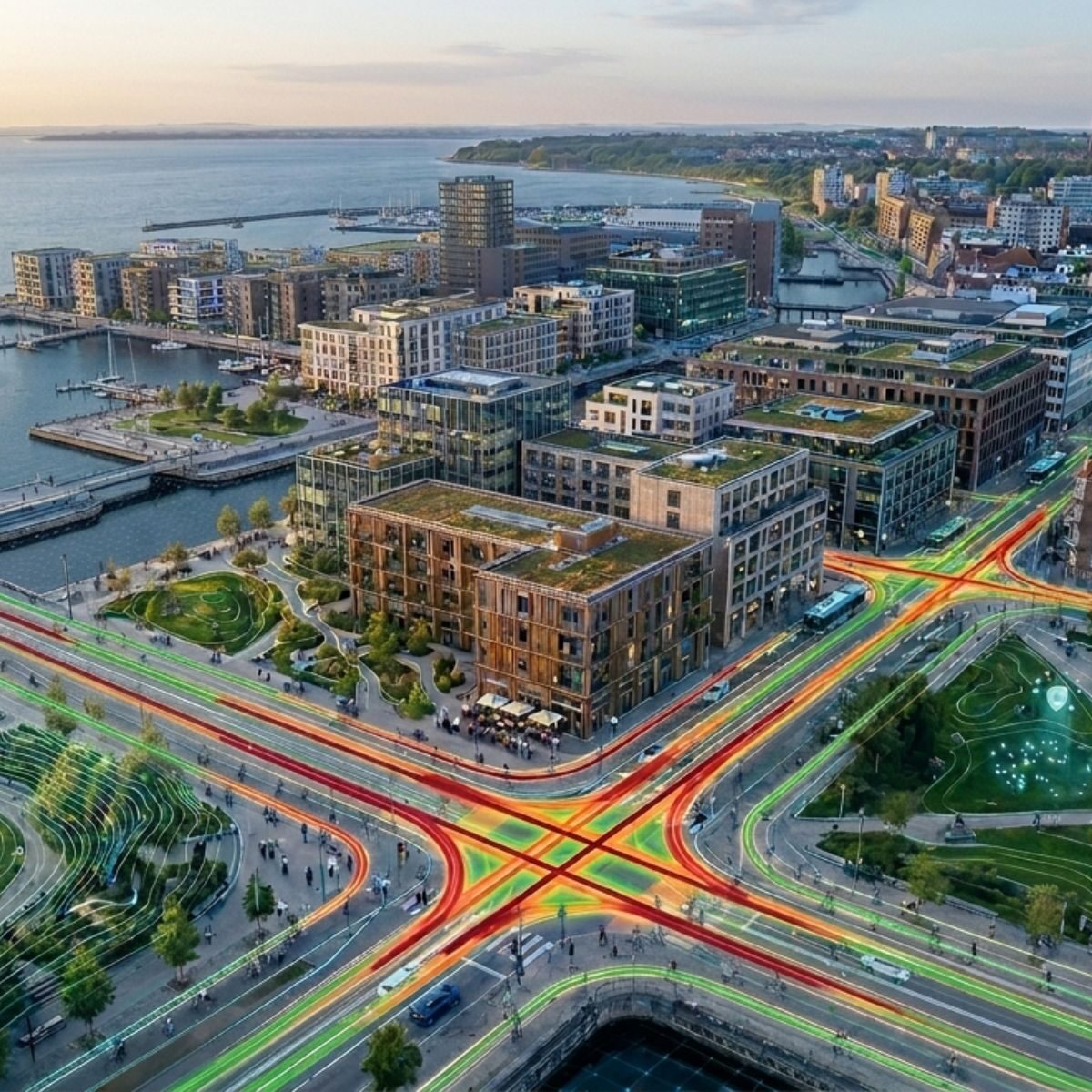
A collaborative project called CITWIN, with Danish, Belgian, Swedish and Austrian partners, will harness digital twins in the urban planning of the future. By presenting infrastructure changes to citizens in a virtual representation of the city, urban development becomes more democratic. Ultimately, the project’s goal is to create greener, more rationally designed and more welcoming cities. Innovation Fund Denmark is investing DKK 2.6 million in the project’s Danish partners.
In the city of the future, all everyday necessities should be within a 15-minute walk or cycle. That is the vision behind the European project CITWIN, which aims to reduce the number of cars in cities and bring citizens closer to urban planning.
Lukas Esterle is an Associate Professor at the Department of Electrical and Computer Engineering at Aarhus University and also the university’s project lead on the European innovation project CITWIN. For him, it is crucial to reduce our dependence on cars in cities:
“Cars create a need for wider roads and require space for parking in cities—often at the expense of human considerations. Moreover, as we know, they are neither climate- nor environmentally friendly, even if they are electric,” says Lukas Esterle.
He goes on to say that he would like to see a future with car-free cities, but that cars today are such an integrated part of our lives that it will take a great deal of rethinking and restructuring of infrastructure to get there. However, it can be difficult to calculate the consequences of these changes, so to address that problem, CITWIN uses so-called digital twins:
“Digital twins are a technology that is very much in vogue and has an incredible number of applications. In our specific project, we have created interactive, virtual copies of cities such as Aarhus,” says Lukas Esterle.
Imagine a Google Maps-like interface with simulated traffic moving through the city’s streets and lanes in real time. The clever thing about this digital twin is that you can make traffic changes—for example by closing a road—and then track how traffic adapts. The digital twin will thus act as a virtual test centre for the municipality’s urban planners, sparing citizens disruption in the real world. And for the project lead from Aarhus University, there is also a democratic point to the cities’ digital twin:
“In the longer term, the digital twin can be turned into an open platform that the city’s residents can access. They would then be able to click into specific areas of the city and provide the authorities with feedback on their proposed changes.”
The digital twin will be continuously updated based on data from the real world. For example, stations in different parts of the city will record the number of cyclists and synchronise with the virtual model.
Aarhus Municipality
Aarhus Municipality has been part of the project as a use case, providing the project’s research partners with insights into how the technology can be implemented in practice. Gustav Friis works day to day in Aarhus Municipality’s Department of Technical and Environmental Affairs and has been the project manager for CITWIN. According to him, it has been very valuable for the city’s officials to exchange ideas with researchers and partners from Denmark and abroad.
“Overall, it has been exciting to get close to the research community, and we very much hope to reach the point where we can use the digital twin to involve citizens in urban planning. Democratisation of data is extremely important to us in Aarhus Municipality,” says Gustav Friis.
He explains that the municipality’s role in CITWIN has primarily been to collect data for the research partners’ various models. During the project period, Aarhus Municipality has visited the partners in Belgium and Sweden. In this way, knowledge exchange across countries has been a significant additional benefit of participating in the project.
International partners
CITWIN is part of an EU initiative called Driving Urban Transition to a sustainable future (DUT), which aims to promote research and innovation that accelerates cities’ transformation towards climate neutrality and sustainability. The project is led by a number of European partners, of which Innovation Fund Denmark funds the two Danish ones from Aarhus University and Aarhus Municipality. In addition, universities from Belgium, Sweden and Austria are represented in the consortium, as well as a Swedish municipality, an Austrian company and the European interest organisation the European Cyclists’ Federation.
For Lukas Esterle, there is great value in collaborating across countries and sectors:
“The whole idea of a project like this is to bring experts together from different backgrounds. The Swedes, for example, are experts in traffic simulation. In Austria, a sophisticated way has been developed to measure how mobility-friendly cities are for cyclists and pedestrians. And the Belgian partner places great emphasis on measuring urban residents’ overall well-being and quality of life.”
Unlike previous similar projects that have only been developed for specific cities, a key part of CITWIN’s vision is that its digital twin should be adaptable to cities all over the world.
Facts
- Innovation Fund Denmark’s investment: DKK 2,553,800
- Total budget: DKK 11,414,717
- Duration: 2023–2027
- Programme: International Collaborations – DUT (Driving Urban Transition to a sustainable future)
Official title: CITWIN (a contraction of ‘city’ and ‘twin’)
About the partners
In CITWIN, Denmark is represented by Aarhus University and Aarhus Municipality. In addition, the consortium includes the University of Liège, the KTH Royal Institute of Technology in Stockholm, the University of Salzburg, Eskilstuna Municipality, the company Triply and the interest organisation the European Cyclists’ Federation.